By Dustin Steerman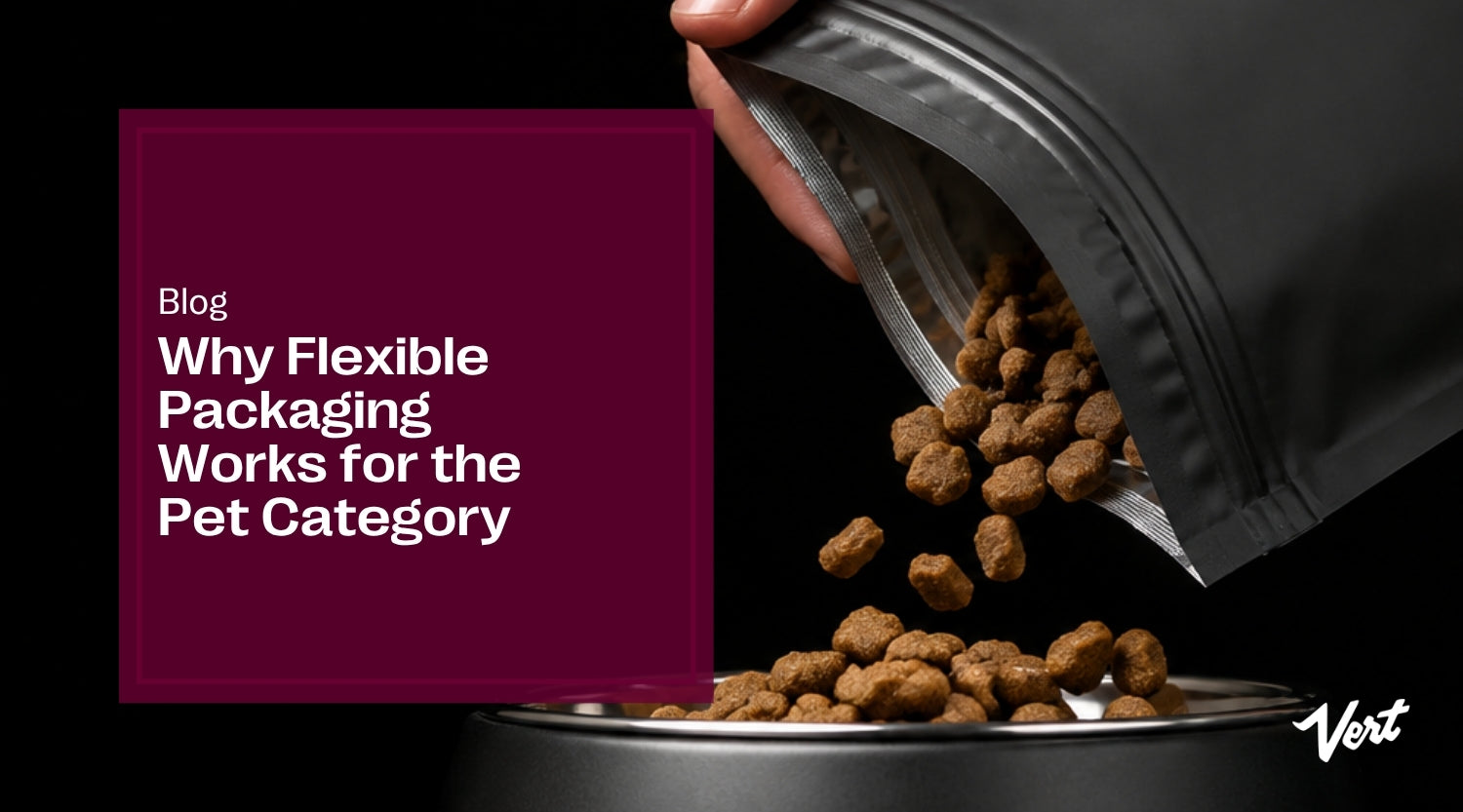
The pet category is crowded and getting more competitive. New proteins, new formats, new functional claims are hitting shelves constantly, and packaging is one of the first things a buyer, retailer, or pet owner notices.
Packaging is a strategic and operational decision, not just a creative one. Most pet brands don't think seriously about it until it's already a problem: a delayed launch, an expensive reprint, a format that doesn't work at retail. This post covers which flexible formats work for which pet products, what to watch for in a packaging partner, and how to avoid the delays and cost surprises that slow brands down.
Why flexible packaging works for pet food

Flexible packaging has become the dominant format in the pet category for practical reasons, not trend chasing.
Pouches offer strong barrier protection against moisture, oxygen, and light, which keeps food and treats fresher for longer. Resealable closures are now expected by pet owners across most formats, from treats to toppers. Pouches weigh less than rigid alternatives, which lowers freight cost per unit at scale. Stand-up formats command more visual real estate at retail than a bag lying flat in a bin. And for DTC brands, pouches ship easily, hold up better in transit, and create a cleaner unboxing experience than glass or rigid plastic.
Stand-up pouches: the workhorse format

Stand-up pouches are the most versatile format in the pet category, and the one we see pet brands gravitating toward most, particularly for treats, one of the fastest growing subcategories in pet right now.
A few reasons treats specifically lean on this format:
- High SKU velocity. Treat brands launch new flavors and limited editions more often than other pet categories, and packaging needs to support frequent changes without long reorder cycles.
- Premium positioning. As the treat aisle gets more crowded, brands are leaning on packaging to signal quality, even at mid-tier price points. Print quality and shelf presence matter more than they used to.
- Reformulation frequency. Ingredient changes like grain-free recipes and novel proteins happen often in treats, and packaging needs to keep pace without big minimum order commitments.
-
Window panels and resealability. Treats are often sold on the visual appeal of the product itself, and pet owners expect to reseal a bag after first use. Both are easy wins with stand-up pouches.
Beyond treats, stand-up pouches work well for dry food and kibble in larger formats with euro holes for mid-size SKUs, and for toppers and mix-ins in smaller formats with resealable zippers built for portion control.
Custom print across the full surface area gives brands room for ingredient callouts, lifestyle imagery, and brand storytelling, useful across all of these product types.
Other flexible formats worth knowing

Stand-ups aren't the only option, and they're not always the right one. A few other formats worth knowing:
Lay flat pouches work well for single-serve portions, travel packs, or lower-cost SKU testing. They have a smaller footprint and are easy to merchandise as add-ons at checkout. Stick packs are growing fast for powdered supplements, meal toppers, and functional add-ins. Portion control is built in, and they perform well at both retail and DTC.
Flexible packaging isn't always the right call, and a packaging partner should tell you that. A few cases where rigid makes more sense: oils, tinctures, and balms need a rigid container for dosing and dispensing. Some treats and supplements need the structural protection a jar or bottle provides against crushing. And some pet products, like supplement jars or topper canisters, are designed to sit on a counter and get refilled. Pouches don't hold up to repeated opening and aren't built for that kind of long term use.
What pet brands need from a packaging partner
The same friction points come up again and again with pet brands evaluating packaging.
Long overseas lead times don't work when you're launching a new protein or trying to catch a trend window before it closes. MOQs that don't match your stage tie up capital and fill warehouse space with packaging you may need to update before you use it all. Managing separate vendors for pouches, boxes, labels, and shippers creates communication gaps and finger pointing when something goes wrong. And pet food labeling has real regulatory requirements. Catching a compliance issue after production starts is expensive and slows everything down.
How we fit
These aren't pet-specific problems. They're the same problems we built Vert to solve.
Our roots are in cannabis, where compliance changes overnight and there's no room for a mistake to become a bigger problem. That's the standard we hold ourselves to now, in every category we work in.
We manage production directly instead of handing your order off to someone else. When something needs to move fast, we're the ones making that call.
If packaging is on your mind, it's worth a conversation. Reach out today.
 By Dustin Steerman
Dustin is a packaging and supply chain entrepreneur with deep experience in print production. From 2017 to 2021, Dustin led the development and scaling of North America’s largest manufacturer of digitally printed pouches. That experience ultimately led to the founding of Vert in 2023. Today, Dustin and his team at Vert leverage their combined expertise in digital packaging and supply chain strategy to help CPG brands launch products faster, navigate packaging complexity, and build supply chains designed for speed, flexibility, and healthy margins.