By Dustin Steerman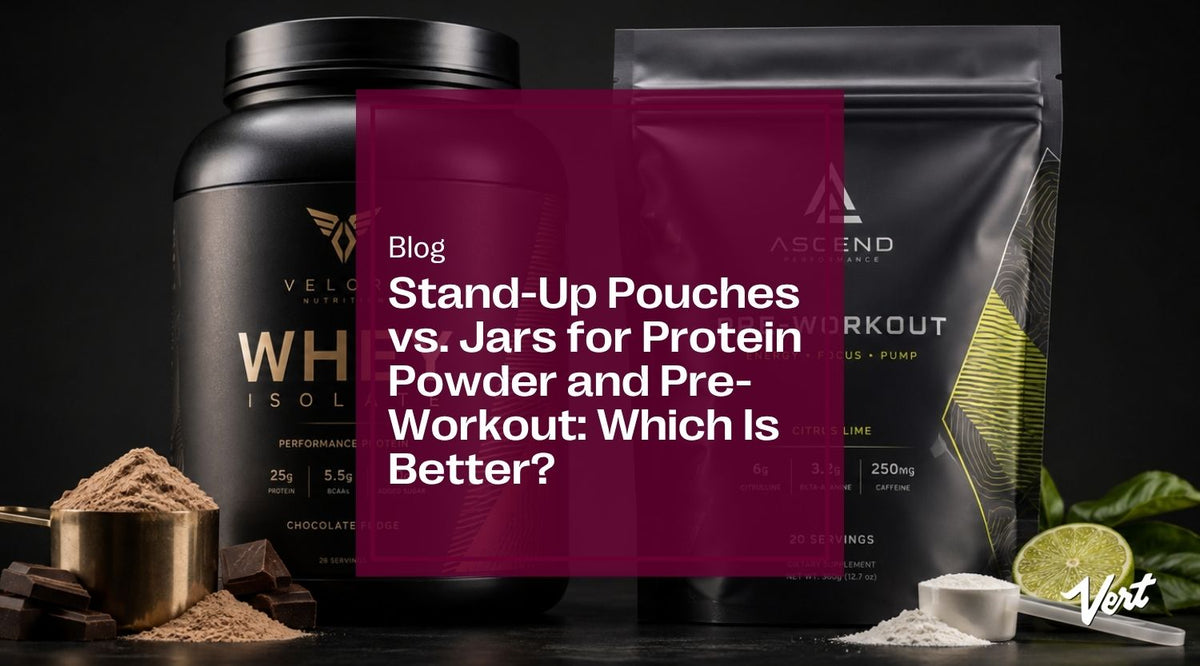
Walk down the sports nutrition aisle and you will see both sides of the packaging debate. Protein powder in a large rigid jar. Pre-workout in a smaller tub. Then, increasingly, the same types of products packaged in stand-up pouches.
So which one actually performs better?
For most brands, there is no universal winner. Stand-up pouches tend to have the advantage when shipping efficiency, storage, package weight, branding space, and SKU flexibility are priorities. Jars tend to perform better when wide-mouth scoop access, rigid structure, and a familiar at-home user experience matter most.
And when it comes to protecting the powder itself, the answer has less to do with pouch versus jar than you might think.
A Jar Does Not Automatically Mean Better Product Protection
One of the first questions brands ask when considering a pouch is whether it can protect a powdered product as well as a rigid container.
It can, assuming the package is specified correctly.
Dry and powdered products are commonly packaged in flexible structures designed to provide moisture and oxygen barrier. High-barrier films can be engineered specifically around the protection requirements of the product inside. High-barrier flexible structures are already widely used for dry and powdered products.
That makes the material specification more important than simply deciding between flexible and rigid packaging.

A protein powder, pre-workout, creatine blend, or hydration product may have different sensitivities based on its formulation. The package needs to account for those requirements, along with seal integrity and what happens after the consumer opens it.
The same principle applies to a jar. The container itself is only part of the system. The closure, liner, seal, and material all contribute to protecting the product.
FDA requirements for dietary supplements similarly focus on using a container-closure system that protects the product against contamination or deterioration.
In other words, do not choose a jar because it looks more protective. Choose a package that is actually engineered for your product.
Where Stand-Up Pouches Have an Advantage
The biggest advantages of a stand-up pouch usually happen before the customer ever opens it.
An empty rigid jar takes up essentially the same amount of space whether there is product inside it or not. Empty pouches can ship and store flat before filling. That difference becomes meaningful when thousands or hundreds of thousands of packages are moving through a supply chain.

Once filled, the shape and lower packaging weight of a pouch can also make secondary packaging, warehousing, and outbound shipping more efficient.
That is particularly important for brands selling through e-commerce, where package dimensions can influence shipping costs in addition to actual weight. Carriers use dimensional weight to account for the amount of space a package occupies relative to its actual weight.
Pouches also give brands a large printable surface. Instead of decorating a rigid container with a separate pressure-sensitive label, the pouch itself can carry the design across most of the package.
That becomes useful when a product line starts expanding.
Chocolate protein becomes chocolate, vanilla, strawberry, peanut butter, limited releases, different formulas, and different fill weights. Pre-workout brands may be managing even more flavors.
A pouch can make that SKU architecture easier to execute, particularly when digital printing is part of the production strategy.
Where Jars Still Perform Better
If pouches were better at everything, the sports nutrition aisle would already be full of them.
It isn't.
One reason is simple: jars are really convenient to scoop from.
A wide rigid opening gives the consumer room to reach into the package, level a scoop, and use the product repeatedly without having to hold the package open. That matters when someone is taking a large scoop of protein every morning for the next month.

Research conducted by TricorBraun found that protein powder consumers cared about scoop accessibility and preferred scoops that were easy to access and appropriately sized for dosing.
A pouch does not necessarily solve that problem. In some cases, a deep pouch can make accessing a scoop less convenient as the product level drops.
Rigid jars also have a familiar physical presence. They stay upright, maintain their shape as product is consumed, and can sit on a kitchen counter, pantry shelf, or gym shelf without changing form.
For brands with consumers who repeatedly scoop large servings at home, that experience can outweigh the logistics advantages of flexible packaging.
Protein Powder and Pre-Workout Are Not the Same Packaging Decision
This is where the comparison gets more useful.
A five-pound protein powder and a 30-serving pre-workout may both contain dry powder, but consumers interact with those packages very differently.
Protein Powder
Protein typically means a larger package, larger serving size, and larger scoop.
That strengthens the case for a rigid jar from a usability standpoint. A wide mouth makes repeated scooping easy, and the container stays stable as the product level drops.
At the same time, a larger package magnifies some of the weaknesses of rigid packaging. Bigger jars require more space throughout manufacturing, warehousing, case packing, and distribution.
For a protein brand shipping a high volume of product directly to consumers, those differences are worth modeling before committing to either format.
Pre-Workout and Smaller Powdered Supplements
Pre-workout, creatine, hydration mixes, and similar products often use smaller overall packages and smaller serving sizes.
In those situations, the usability advantage of a wide-mouth jar may become less important, while the space and material efficiency of a pouch becomes more attractive.

That does not mean every pre-workout belongs in a pouch. It means the package should be chosen around how the customer actually uses the product, not simply around what competitors have traditionally used.
For a broader look at format, materials, compliance, sizing, and other decisions in this category, see our guide to choosing sports nutrition packaging.
Stand-Up Pouch vs. Jar: Quick Comparison
| Consideration | Stand-Up Pouch | Jar |
|---|---|---|
| Product protection | Strong with the correct barrier structure and closure | Strong with the correct container, seal, and closure |
| Empty package storage | Major advantage | Requires more space |
| Packaging weight | Lighter | Heavier |
| Shipping efficiency | Typically stronger | More package cube |
| Scoop access | Can be less convenient in deep pouches | Major advantage |
| Rigid structure | No | Yes |
| Branding space | Large printable package surface | Typically label or direct decoration |
| Multiple SKUs | Highly flexible, especially with digital print | Depends on container and decorating method |
| Large protein formats | Efficient but may trade off scoop convenience | Strong consumer-use case |
| Smaller pre-workout formats | Strong use case | Familiar and functional |
| E-commerce | Strong potential | Can require more shipping space |
The Packaging Cost Is Bigger Than the Price of the Package
This is where brands can make the wrong comparison.
If a pouch costs one amount and a jar costs another, it is tempting to simply compare the two unit prices.
But the package itself is only one part of the cost.
How much room does the empty packaging take up in your facility or co-packer's warehouse? How many finished units fit in a case? How efficiently do those cases palletize? What does the package do to outbound shipping dimensions? Does your current filling partner already have the equipment to run it?
Then there is SKU complexity.
A brand launching one protein powder has a different packaging problem from a brand managing 14 flavors across protein, creatine, hydration, and pre-workout.
The format that looks cheapest on a quote can become more expensive once it moves through the rest of the operation.
That is why packaging decisions should happen with the full supply chain in mind.
Your Volume Can Change the Answer
The right package at launch may not be the right package at scale.
Early-stage brands are often optimizing for manageable order quantities, speed, and the ability to make changes without sitting on months of inventory.
As volume grows, different production methods, sourcing strategies, freight considerations, and purchasing economics become available.

That should factor into the format decision from the beginning.
If you know you are likely to add flavors, change fill weights, enter retail, or significantly increase volume, the question is not just whether a pouch or jar works today.
It is whether the packaging system can grow with you.
So, Should You Choose a Stand-Up Pouch or a Jar?
Start with how the product needs to perform. Then ask your customers. Packaging affects how people scoop, store, open, reseal, carry, and ultimately experience the product, so customer input should be part of the decision.
If freight efficiency, storage, SKU flexibility, e-commerce, and a large printable branding surface are high priorities, a stand-up pouch deserves serious consideration.
If easy scoop access, rigid structure, and repeated use from a large container are central to the customer experience, a jar may still be the better package.
For some brands, the answer may even vary across the product line. Large-format protein might stay in a jar while pre-workout, creatine, hydration, refills, or smaller sizes move to pouches.
The important part is not forcing every product into the same packaging format. The best choice is the one that works for your operation and gives customers the experience they actually want to keep buying.
Compare the Whole Packaging System Before You Commit
At Vert, we work across flexible and rigid packaging, which means the conversation does not have to start with, “Which package do you want?”
It can start with the questions that actually determine the answer.
What are you filling? How much? How will consumers use it? Where will it be sold? How many SKUs are you managing today, and how many are coming next?
From there, you can compare the package itself along with barrier requirements, printing, filling, storage, freight, and what happens as volume increases.
Choosing between a stand-up pouch and a jar is not just a packaging decision. It is an operational decision, a customer-experience decision, and ultimately a scaling decision.
Not sure which format makes the most sense for your product? Talk with the Vert team. We can help you compare pouch and rigid packaging options based on your product, volume, budget, and growth plans before you commit.
 By Dustin Steerman
Dustin is a packaging and supply chain entrepreneur with deep experience in print production. From 2017 to 2021, Dustin led the development and scaling of North America’s largest manufacturer of digitally printed pouches. That experience ultimately led to the founding of Vert in 2023. Today, Dustin and his team at Vert leverage their combined expertise in digital packaging and supply chain strategy to help CPG brands launch products faster, navigate packaging complexity, and build supply chains designed for speed, flexibility, and healthy margins.